
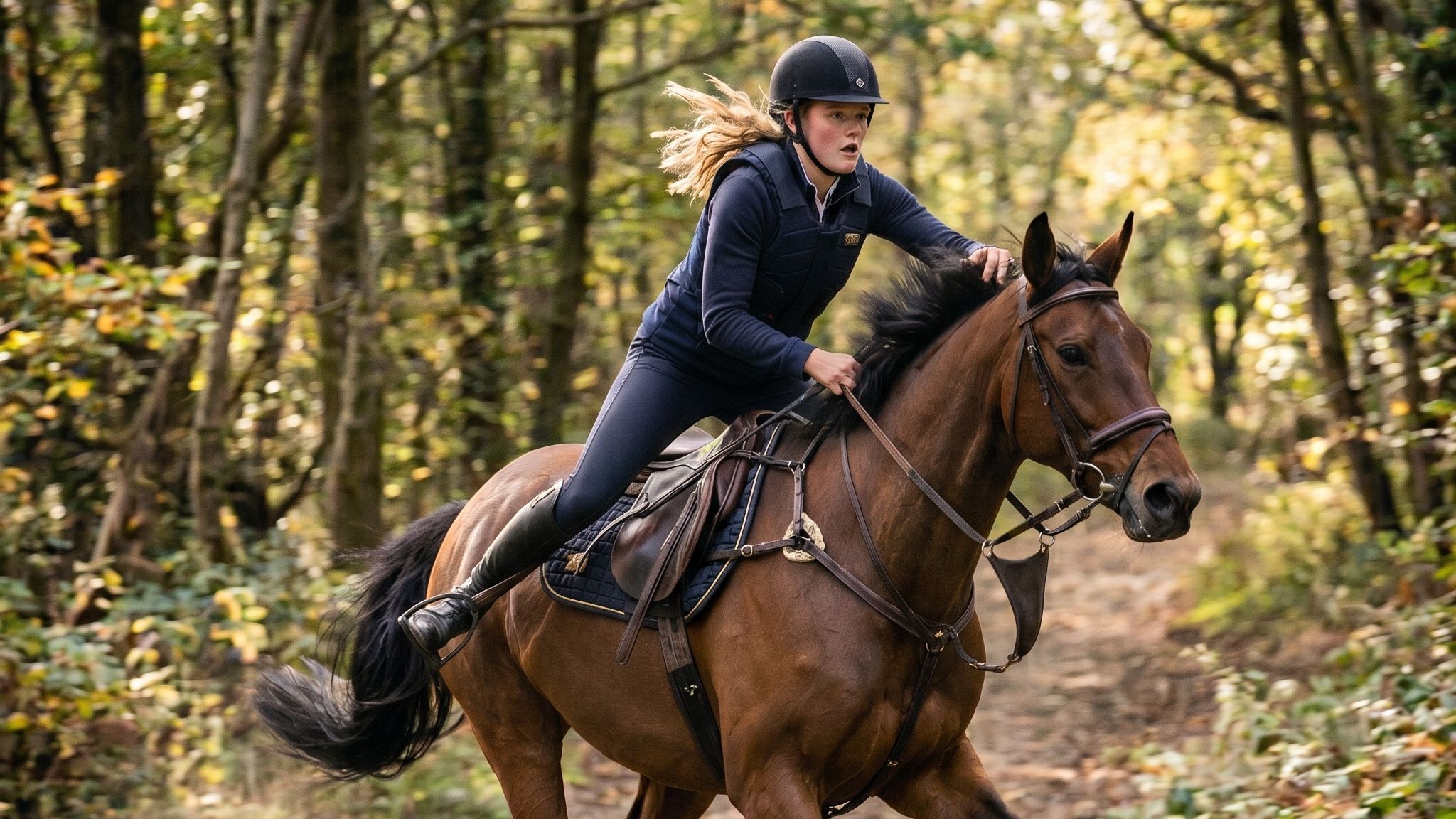
"He just exploded out of nowhere!"
It’s a phrase uttered in almost every stable yard around the world. We have all experienced it, or at least witnessed it: a horse that seems perfectly quiet one second, and the next, they are spinning, shying, or bolting down the track. When these moments happen, it feels terrifyingly unpredictable. We label the horse as temperamental, spooky, or unpredictable.
But from the perspective of equine behaviour science, horses rarely move from total relaxation to a high-intensity flight response without warning. They don't jump from 0 to 100 in a split second. What actually happens is a steady, incremental rise in emotional arousal that happens right under our noses, and we miss the whispers until the horse is forced to scream.
If you want to keep yourself safe, build deep trust, and eliminate blowups under saddle or on the ground, you need to learn to read the "2% increments" of your horse's emotional scale.
The 0–100 Emotional Scale
To become a truly evidence-based trainer, you must stop viewing behaviour as a simple binary of "good" and "bad." Instead, start viewing your horse’s mental state as a fluid scale from 0 to 100.
-
Score 50: This is your absolute baseline of relaxed grazing in a familiar paddock with friends. The nervous system is functioning properly in the parasympathetic state ("rest and digest").
-
Score 60–65: This is the ideal learning zone. The horse’s emotional level is slightly elevated because you have caught their attention, put a halter or bridle on, and are asking a clear question. They are alert, interested, and engaged.
-
Score 80+: This is the danger zone. The sympathetic nervous system (fight-or-flight) has taken the wheel. Adrenaline is pumping, and the brain has physically shut down its capacity to process logical signals.
The secret to great training isn't forcing a horse to stay at a 50 forever; it’s about you controlling the scale so the horse never hits an 85.
Spotting the 2% Increments
When a horse explodes under saddle, it is usually because they were already sitting at a 75 or 80, and a tiny trigger pushed them over the edge. The rider didn't notice the climb from 65 to 75.
To catch these moments early, you must look for tiny, 2% changes in your horse's physical characteristics. These are the micro-signals that tell you the emotional level is rising:
-
Head Elevation: This is almost always the very first thing to change. When a horse becomes anxious, their head lifts. A high head allows them to sight danger over the horizon. If the poll climbs, their emotional level is rising.
-
Ear Direction: Sharp, rigid pricking of the ears toward an object, or an uncharacteristically rapid flicking of the ears, indicates heightened vigilance.
-
The Muzzle and Jaw: Look for a tightly clamped mouth, a rigid chin, or subtle wrinkling around the nostrils. A relaxed horse has loose, soft lips; an anxious horse locks their jaw.
-
Muscle Tone: When you stroke your horse's neck or shoulder, does it feel soft, or does it feel like a coiled spring? Increased muscle rigidity means the sympathetic nervous system is prepping the body to run.
If you feel your horse shift from a 65 to a 67, don't wait for them to hit an 80. That is your cue to step in and change the conversation.
Work with what the horse wants to do:
When a horse gets wound up, our natural human instinct is to pull on both reins, try to force them to stop, and demand they stand still. But here is a fundamental truth of horse behaviour: you cannot force an overly emotional horse to stand still.
If a horse has a mountain of anxious energy coursing through their body, forcing their feet to stay glued to the ground only increases the cooker's internal pressure. Eventually, they will boil over.
Instead of fighting the energy, accept it. Say to your horse, "Thank you for the energy, I’ll take that, but we are going to move in the direction and pattern that I choose."
Direct that energy into clear, predictable movements. Ask for small, focused circles, leg yields, or transitions. By giving them a highly predictable question to answer, you engage their cognitive brain. When they give you the correct step, give them an immediate release of pressure (negative reinforcement) followed by a soothing scratch on the withers (positive reinforcement). This combined reinforcement replaces their panic with clarity, naturally lowering their emotional level.
The Illusion of the Emergency Stop
Many riders rely on emergency measures like a sharp, unpracticed "one-rein stop" as a safety net. But pulling a horse’s head drastically to the side when they are already galloping at a flat-out survival pace is incredibly dangerous and can easily cause a horse to lose balance and fall over.
True safety isn't an emergency brake; it's a rock-solid foundation. You need to train a structured "stop lesson" cleanly on the ground and under saddle in a calm, low-arousal environment before you ever need it.
Take Control of the Bubble with Kandoo GOLD
Learning to read your horse’s emotional level and regulate their energy takes time, observation, and a structured system.
Inside the Kandoo GOLD Subscription, we give you the step-by-step framework to become completely attuned to your horse’s micro-signals. Our digital training milestones are designed to help you build an impenetrable communication bubble, ensuring your horse stays safe, responsive, and mentally relaxed in any environment you enter.
Ready to develop the ultimate safety net? Click here to join Kandoo GOLD and master the art of reading and regulating your horse today.
